The Brussels School of the Clear LineHergé’s Process


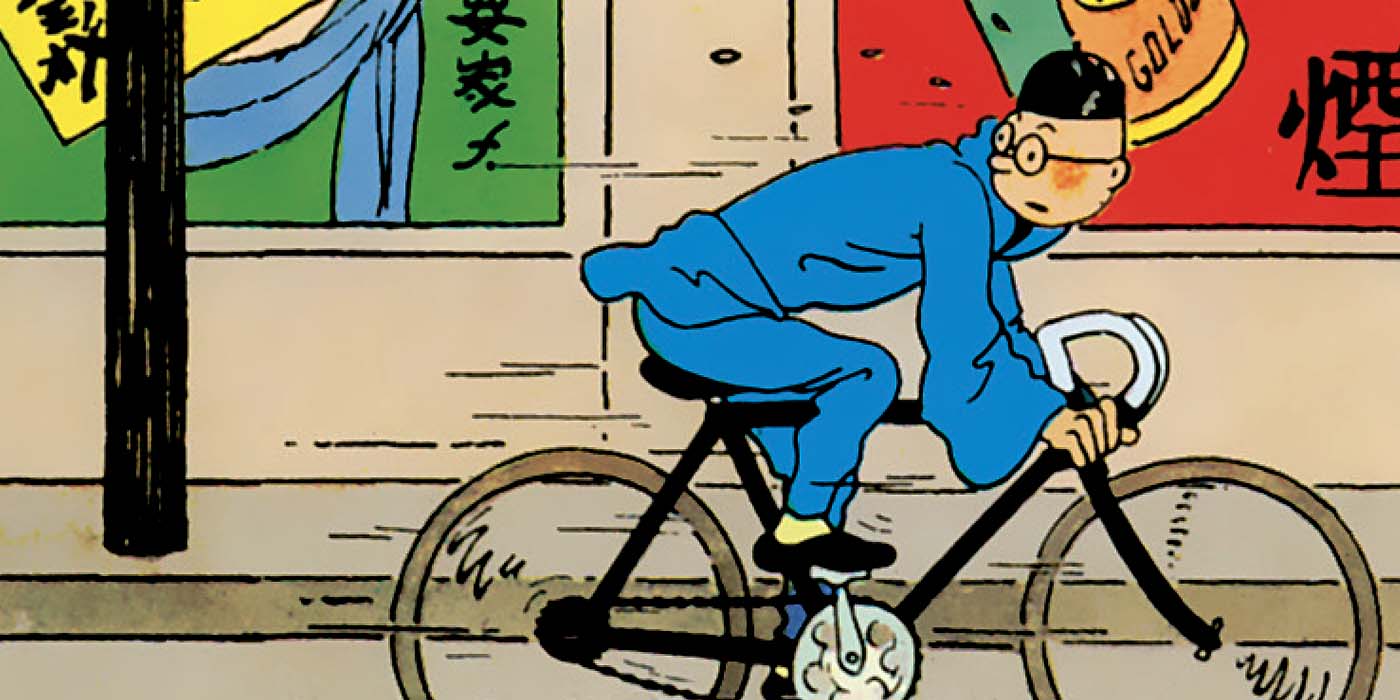
Hergé was a master of bande dessinée, or cartoon illustration, imbuing his line drawings with personality and spirit. While his style was painstakingly precise, it never failed to express the pure joy he took in imagining and inventing new worlds.
Like every artist, Hergé imitated others before finding his own style. His inspiration came from the portraits in the renowned Larousse dictionary, as well as from a variety of French illustrators, including Benjamin Rabier and French illustrator René Vincent. He also admired 1930s-era American comic strips for their clarity, and Chinese drawings for their order and simplicity.

The Brussels School of the Clear Line

Hergé’s philosophy is encapsulated in a technique he created known as the “Brussels School of the Clear Line.”
Hergé saw the cartoon as an art form, in which forms and figures must work together harmoniously. “One tries to eliminate everything that’s graphically redundant, to stylize as much as possible, and to choose the line that’s most expressive.”
Back to TopHergé’s Process

In a Bind: HERGÉ with the stars of his other comic book series Quick & Flupke
Working in an era before the computer sped the illustration process, Hergé undertook painstaking work to achieve the results he wanted:
“After writing a two- or three-page synopsis, I do the découpage on small sheets, where I rough out a few sketches. When that’s done, I go on to the real work of the large-format plates. And on those plates, with all the energy I can muster, I draw, I modify, I erase, and I start again, until I’m satisfied. Then, frame by frame, I trace all the drawings. This means that among all those lines that are intermingled…I choose the one which seems to me the best…all while trying to keep the spontaneity, freshness, and energy of the first sketch.”
Back to Top
